Show Notes
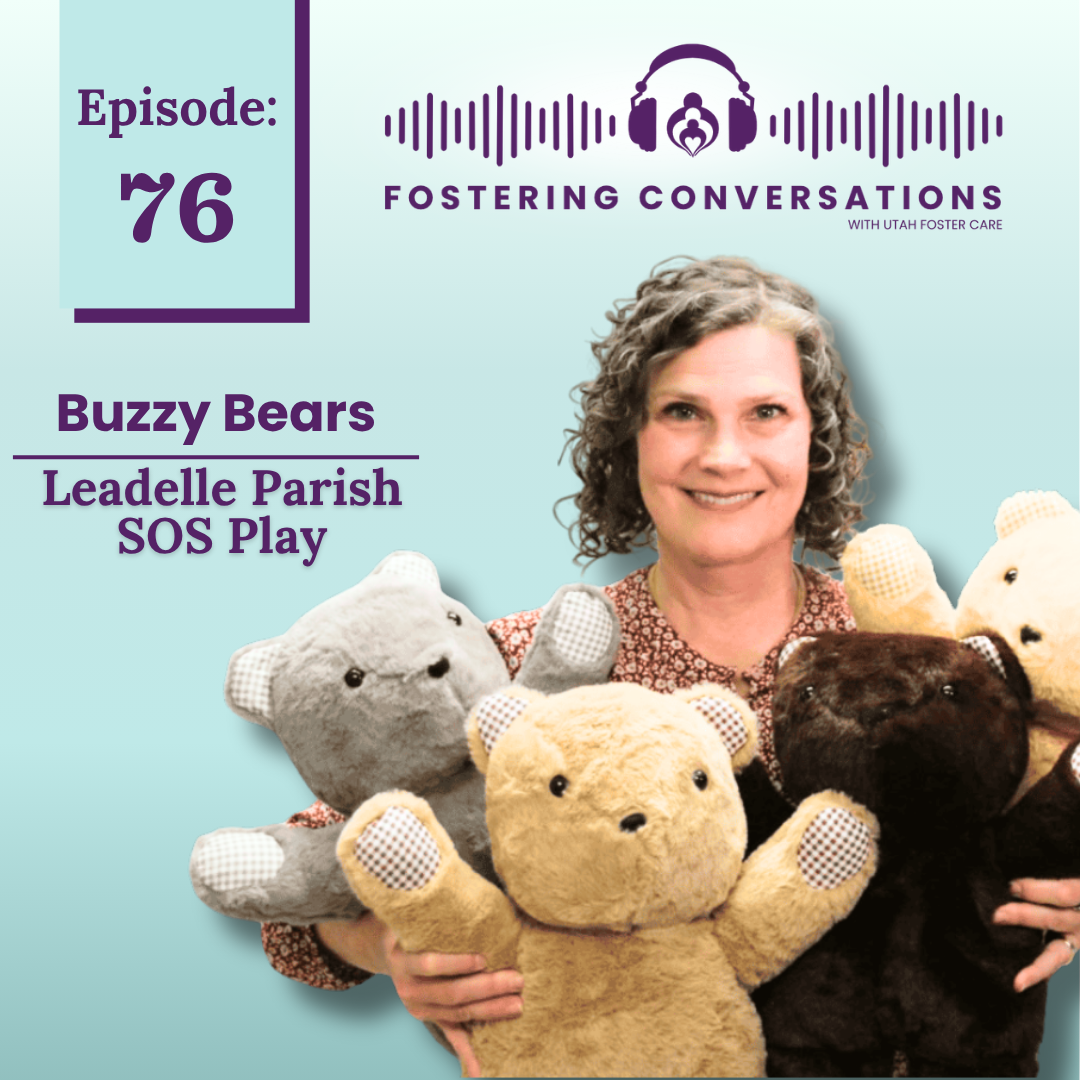
On this episode, we talk with Leadelle Parish about her regulation invention for kids, called Buzzy Bears. Leadelle discovered the calming effects of bilateral stimulation while managing her own chronic illness, she never imagined it would lead to the creation of the Buzzy Bear. Inspired by the dramatic improvements she saw in her grandchildren’s ability to handle stress and transitions, she set out to create a child-friendly version of a therapeutic tool commonly used in EMDR therapy.
In this conversation, Leadelle explains how the Buzzy Bear delivers gentle alternating vibrations that may help calm the nervous system and support emotional regulation. She shares the results of a pilot program with foster families in Vernal, Utah, where caregivers reported meaningful improvements in children’s ability to regulate emotions, manage transitions, and cope with overwhelming feelings. The discussion also explores the unique challenges children in foster care face and how a comforting, therapeutic stuffed animal can provide both emotional support and a practical self-regulation tool. Listeners will learn how individuals and organizations can help place Buzzy Bears into the hands of children entering foster care across Utah. To learn more about Buzzy Bears, visit sosplay.com. To learn more about foster care or get involved, visit utahfostercare.org.Leadelle Parish Bio
Leadelle has grappled with chronic illness for most of her life. Because of this, she monitors stress on her body several ways, including heart rate variability. In 2021, while visiting family on a road trip, she was introduced to bilateral stimulation. Upon receiving this type of therapy, she noticed that her heart rate variability had improved dramatically. She immediately looked for a device that would allow her to continue this therapy on her own time.
Several months later, Leadelle noticed that her grandchildren were exhibiting stress when transitioning between the households of their divorced parents. Working on a hunch that if bilateral stimulation was able to help her so significantly it would also benefit children, Leadelle broke out the device she had been using for herself and set it up for her grandchildren. Their little shoulders relaxed, and they started taking deep breaths. After a few minutes, they were calm, regulated, and happily playing with each other. She noticed that if we had the kids utilize bilateral stimulation when returning home after parental visits, they showed reduced signs of stress. An idea started to take root. This was the second beginning.
While the device providing bilateral stimulation was helpful, it was also utilitarian, somewhat clunky, and required the assistance of an adult to get it set up. Leadelle remarked that it would be more beneficial if we could find a way to deliver this therapy in a cuddly stuffed animal that kids could access entirely on their own wherever and whenever they needed it. After years of troubleshooting and testing her theory, the buzzy buddies were born.
We at SOS Play are thrilled that we can now share the benefits that come from bilateral stimulation with all of you. We are especially excited to be able to deliver it in an adorable, intuitive, easy way that even young children can grasp quickly. We offer both a toy and a tool for kids, empowering them to take care of their nervous systems. Our goal is to provide an intuitive approach to supporting children, and we believe these bears are a powerful way to accomplish that.
Transcript:
[00:00:00] On today’s episode of Fostering Conversations, we’re meeting with Leadelle who’s the founder of SOS Play. She has created the Buzzy Bear, which is meant for all kids entering foster care.Amy: Welcome to Fostering Conversations. I’m your host, Amy Smith. Today we have Leadelle, who is the founder of SOS Play. Thanks for joining us today.
Leadelle: Thank you for having me. I’m so excited to be partnering with Foster Care
Amy: yes, I am too. So I am just learning about your product, which is the Buzzy Bear. So tell us a little bit about what the Buzzy Bear is and how this all got started.
Leadelle: Yeah. Let me take you back. My story ends with this delightful stuffed animal that delivers a therapeutic called bilateral [00:01:00] stimulation. And you would think it would start with children, but it actually started with me. I have chronic illness, and so I regularly track stress on my system by measuring things like heart rate variability.
And in 2021, I was introduced to a therapy called bilateral stimulation. It’s used in therapy regularly to help process trauma safely with therapists. But it’s also helpful independent of therapy just to help regulate and calm the nervous system. So I was– I applied it, I noticed an impact on my heart rate variability, and decided I needed to have it at home.
And so I regularly applied bilateral stimulation to myself. My grandchildren were struggling in the transitions between divorced parents’ homes, and so I asked my daughter if she’d be okay if we just applied bilateral stimulation, and she was. And so we were unprepared, though, for the dramatic [00:02:00] response the children had.
Their little shoulders came down out of their ears. They started taking these deep, reflexive breaths. They were calm and happy and just regulated. And I was so impressed by it, I thought, “Where’s the teddy bear that delivers this?” It’s– Obviously, it would already exist, right? Because it’s so genius. And I kept looking for EMDR bear, bilateral stimulation teddy bear, stuffed animal, you know, th- stuffed animal that…
And I couldn’t find it because it didn’t exist yet. And so we built it, and this cute teddy bear was built to help my grandchildren in their trials and their struggles. it’s just been a remarkable event. I built the first prototypes for Christmas presents in 2024, and then we’ve been working and did development to make a scalable product, and have just started selling.
December ’25, we started selling.
Amy: Okay. So when you guys first were using this on yourself and then originally on your [00:03:00] grandkids, were you guys just manually doing like tapping, like EMDR type
Leadelle: There’s EMDR equipment. So I actually had a piece of EMDR equipment. My aunt is the one that introduced me, and she’s an EMDR therapist. so she handed me her little EMDR machine. She didn’t do any therapy with me. She just said, “I think this would be helpful for you.” And so she handed it to me, and I was like, “I know what that is.”
And, it was really helpful. And so I bought a EMDR machine because you can
Amy: Yeah. Yeah. But obviously a little kid is not going to be using a machine and hooking it up
Leadelle: they did. They did, but it was, yeah, it was clinical and it was
utilitarian, and it needed adults to set it up every time, and it just it was helpful. No doubt it was helpful, but it wasn’t easy
Amy: Okay. So tell us a little bit about what bilateral stimulation is. I think a lot of people know the term EMDR. M- maybe they don’t know what it is, but they’ve heard it. But bilateral stimulation is a little bit more[00:04:00]
Leadelle: Yeah, abstract. Absolutely. So when you understand it, you’ll understand the term. Bilateral stimulation is simply triggering the right side of the body and the left side of the body alternately. And so you can do it tactically, you can do it with sound, you can do it with light, with vision. And they use all of those in processing trauma with therap- therapy.
The bear delivers tactile bilateral stimulation, so it will have a motor in one paw that will vibrate, and then the other side will vibrate. And if you’re hugging the bear or if you’re holding the paws, you’re getting that trigger. And what they theorize, th- there really isn’t solid understanding, but they theorize that by triggering the right side of the body and the left side of the body, you trigger the left side of the brain and the right side of the b- brain alternately, and that mimics REM sleep and allows you to process safely
Amy: Yeah, so I mean, this is a scientific thing that you’ve put into a cute, comfy, stuffy Exactly. Yes
I love that. So tell us a little bit– [00:05:00] You said you’ve just started selling them last year but you have decided that kids in foster care would really benefit from this. As you say, it is to help process trauma, to help regulate, and all kids need this, right?
But especially a child in foster care who’s experiencing an immense amount of trauma. So tell us a little bit about how you got connected with foster care and what your goal is with the foster care program.
Leadelle: Yeah. I was at a, a mental health conference at UVU, and a foster mom who’s a therapist found me and found the bear, and she was so excited and came back and talked to me a couple different times and she said, “This needs to be in foster care,” and I started to cry, and I just… I had a physiological response.
I knew that sh- what she was saying was true for me, and I had to figure it out. And I didn’t know what I was doing. I had not been involved in foster care. I don’t have foster experiences. But she had connections with a coordinator and had me [00:06:00] call and c- you know, I just got some information got maybe the scope of the land a little bit, the lay of the land, and I really was shooting in the dark for how to accomplish this.
But what… I had a benefactor that I- had told me when I started that he would help me place bears in places that it could make an, a big impact, and I believe foster care was that, was exactly that. And so I drew up that favor, called up that favor and said, “Let’s do it. Let’s do a pilot, and let’s just see if it’s helpful.”
Because some kids that have had trauma, for some kids that have had trauma, bilateral stimulation can be a little bit triggering. And so we want, we always want them to be comfortable, right? And so we weren’t sure if it would be helpful, so in this setting. And so we placed 10 bears in the Vernal chapter of foster care, and it was we had [00:07:00] foster moms rank emotional regulation at the beginning of the study and then 30 days later.
And all we gave them was the bear and a little book that talks about big feelings getting small enough to hold with the bear, because that’s basically what it does. It doesn’t make them go away, It helps shrink them to the point that they’re kid size,
those big feelings. And it’s really amazing at what happens.
So we asked for those responses, and we asked for times that they used it. We asked for any s- suggestions they had to help us make a product that was more fit for what they needed. The responses really were humbling and brought tears to my eyes quite often. The emotional regulation, these kids ranked on a scale of one to 10.
Scale one is my kid falls apart at the drop of a hat, and ranking at 10 is my kid is perceptive of their feelings and can handle any transitions. So that, that’s the scale of [00:08:00] it. And these kids, most of them ranked one to three, which makes sense, right? They’ve got a lot of things that they’re carrying.
And so one to three, that means that those parents are dealing with a lot all the time
Amy: Exactly. Yeah
Leadelle: They’re… Because you have to be the prefrontal cortex for this kid that doesn’t have a prefrontal cortex fully developed, and so that’s going to be you on call all the time. And what we noticed is that in the 30 days, the average in regulation increased by 1.7 points.
That is significant. Many kids doubled, so they went from a one to a two, or from a one to a three. One child went from a three to an eight. Can you imagine the impact for that parent
and for the child to be able to know that they can handle things now? Wow. we have eight out of nine increased.
one child did- stayed the same, which is also significant because we stay the same in hard times, and they [00:09:00] talked about it helping in transitions. They helped- talked about it helping transition to sleep. It helped them, in calming down when emotions were big.
We hadn’t even gotten home and one of the moms texted me and said, “I think this bear is actual magic.”
and then she described the situation and she said that she’d had an eight-year-old that was more reactive, and she’d a- been asked to do something and being defiant. And the mom said, “Okay, it’s time for a little bear time.”
And two minutes later with the bear, the child was happy, and regulated, and just went upstairs and did what they’d been asked.
Amy: You’re like, “What the?”
Leadelle: So it is like actual magic. I didn’t appreciate how much it was going to help the children and the moms t- at the same time,
Amy: I was gonna say, I feel like there needs to be a mom bear and a child bear because
Leadelle: I use my bear every day. I use my bear morning and night, and it just… And I have the other [00:10:00] EMDR machine that I already bought, right? But I choose my bear. I don’t know, there’s something about it being in that soft, cuddly form is just remarkable. But can I share some of the things the mom
Amy: Yeah, I was gonna say share some specific things about what, Yes, share what you have. Yes.
Leadelle: So s- here are some of the things the mom said. We wrote a brief about this, so I’m quoting from my brief. But quoting a mom, “Without a doubt, the buzz is a great distraction. There was one instance when she was feeling pain from a hangnail. We prompted to use the buzz, and she was calm within minutes This was a kid that was really having a hard time diverting from that thought process
Amy: sure. And I think that’s actually really important to recognize. Someone’s gonna hear that they had a hangnail and that way… Yes, hangnails actually can be the end of the world for a kid with immense trauma, and so I think that’s really important to rec- we’re not even talking about crazy massive things.
Kids can really get fixated on these small things and not go to sleep, have a total meltdown. That’s
Leadelle: And it’s something you can’t [00:11:00] easily interrupt,
right? so it’s just amazing th- that just h- turning on this little bilateral stimulation can help. And the, and it has three speeds, and so kids can choose what’s more comfortable for them. And I don’t know, I don’t know what speed she used, but whatever it was, it helped her.
Another mom said, “The emotional regulation the bear provided was amazing. I was surprised when it worked so quickly to calm them down and help them hear what I was saying. Very happy with our therapy f- bear. 100% recommend.”
Amy: That’s awesome.
Leadelle: Yeah. Let’s see. This is from maybe a more informed mom. “I think that utilizing a bear that helps calm the autonomic nervous system is an amazing tool and strategy that would help with kids with PTSD, trauma, or even attachment issues in care.
I think it would help them learn to regulate on their own.”
Amy: Yeah. Which, that’s a huge ask, right? We’re just grateful if we can get kids to regulate, co-regulate, but if a child could actually learn to regulate on their own, that actually is life-changing for them
Leadelle: And that’s what I set out to create was the, the [00:12:00] support that in their toughest moments, kids would know we, we got their back. We can help them. We can help them be- feel supported in their toughest moments. When we’re in those big emotions, we feel quite isolated.
Amy: Oh, for sure.
Leadelle: We feel quite alone and the, and and just in this acute, this big world.
But I saved the best quote for the last.
This this one really brought tears to my eyes. “Sometimes as a foster parent, and even more as a foster child, it seems there is no reprieve from trauma, sensory overload, meltdowns, and life just being too much.
Having something to help with regulation in the form of a teddy is genius and so appreciated.”
Amy: Yeah. Yeah. No, it’s so true. And I didn’t tell you this, but I actually was a foster parent for four years. I know firsthand what these parents are talking about. And it’s ironic because a lot of the times when kids come to you in the middle of the night and whenever, a lot of my kids came in the middle of the night, they are given a [00:13:00] stuffy or a blanket or something cozy and warm from the caseworker or whoever’s dropping them off.
But how much more incredible would it be if they actually were given something soft and cozy like one of these bears that can actually be comforting and help with these emotions and the, these
feelings,
Leadelle: So it can be comforting and therapeutic at the same time.
Yeah.
I think that I was led to this point, and I think that what we’re going to accomplish is going to only grow from here. I think what we have is evidence that it is quite helpful for these children and these parents in these settings, and I really wanna make it happen for every child that is placed in Utah in foster care.
Amy: I love that. Tell us a little bit about how the BEAR works.
Leadelle: Yeah. Let me give you a demonstration. So this bear is designed to be very simple. So in the back there’s a zipper and there’s a little [00:14:00] control box. This bear is actually washable, so this control box comes out, comes – detached. I’ll just show you, ’cause why not? I can. So it comes out and then you take this out and you can wash this bear.
Amy: Okay, you really are a grandma. You thought of
Leadelle: I thought of- I have been through a few things. And so you can throw this in the wash on gentle cycle. Everything that stays in the bear can be washed with the
bear. And then it operates on three AAA batteries because You can always find AAA batteries,
right? and then it’s very simple.
There’s a dot on here that matches a dot on here, and you just plug it in. Oh, I forgot I had this cool little tool that we just added to make it easier. And so then once it’s plugged in, you can tuck that pocket back in the pocket, and then it’s got a switch in this ear and it’s all one switch. So you hold the switch for a second and a half, and then it starts to vibrate, and it starts to vibrate on a medium speed. and it’s buzzing in my left left left, right
[00:15:00] And it’s very gentle. We tried a number of different motors with a number of different kids and found that they all wanted a very gentle… They’re very sensitive, and so they wanted a very gentle buzz and maybe that’s why I love it so much. So anyway, so it starts vibrating. So it’s vibrating here.Then you can change the speed by pressing the button again. So it starts on a medium speed, and then it goes to a faster speed.
Amy: OK。
Leadelle: And then it goes one more time. You can go to a slower speed, and it’s a slower, longer speed.
So it’s
Amy: okay. And are most kids holding this or are they holding it like
Leadelle: So my grandkid… Let me show you how my grandkids use it.
They actually tuck it in their armpits and hold it like that.
That’s how they, That’s how they, hold it. And my granddaughter, who’s eight, or she just turned nine, she said, “I like the fast speed best, but I find that I calm down faster with the slow speed.” Isn’t that in- amazing that she’s got That kind of intuition, insight? playing with it and paying attention to how she’s [00:16:00] feeling.
Yeah. And so it’s very calming. It and just, it just soothes. I don’t know. I don’t understand all of the science. And there’s something about having it in a bear that there’s something relational with that, with this form, and you feel connected to this form, and you can identify with this form that’s delivering
Amy: Yeah. You think of all the stuffies that kids have, right? They love stuffies. And then you’ve seen the funny reels that are like, moms grow up and then their pillows become their stuffies, ’cause we
all have 4,000 pillows on our bed. And it’s there’s just something about having the tangible soft thing to hold.
So yeah,
Leadelle: And then this does have a 10-minute timer, so it can be used in a time- so that it protects the battery is mostly
what it is. To protect the battery.
Amy: never gonna turn it off.
Leadelle: And then every time you press that button in the switch, i- in the ear, it will reset the timer. So if you need it for longer, you just press the button, change the speed,
and it gives you a little bit [00:17:00] longer.
And I will say, when you’re really activated, 10 minutes goes like that.
Amy: I’m sure. But that’s the nice part is that kids can just press the button again and
it turns on again.
So that’s awesome. What are some of the… I- you said vaguely what some of the ways that people are using them or when they’re using them. You said you use it morning and night. Are these bears just sitting around and a kid’s supposed to go grab them?
Is mom supposed to remind, “Hey, go grab your Buzzy Bear”?
Leadelle: Yeah, I’ve heard it, I’ve heard it work both ways. And I wasn’t sure when I started this how the kids would react to that, if they would go and reach for it on their own or not. And we did develop a little book. I should have brought one. I don’t have one here, but it’s a little, it’s a little picture book that introduces the bear and helps kids go…
It talks about being worried, it talks about being scared, it talks about being angry, and it talks about being sad, and all of those feelings, and every big feeling can get small enough to hold. And so I recommend introducing the bear that way, with the little book that helps kids [00:18:00] understand that this is their buddy that’s gonna help them with these big feelings.
And so if it’s introduced that way I think it’s helpful. But I will tell you that my grandkids didn’t have that book ’cause I just devel- developed it. I developed it for foster care, actually. I didn’t have the book before, but I knew that the kids needed a way to be introduced for, to it in the families,
and so I developed the book for that.
But my grandchildren my daughter called me one day and she said, “You were wondering if the kids would use it on their own. I just looked downstairs and there’s a little circle of kids with a little circle of bears.”
And yes, they will use it. They will recognize that it’s helpful. And sometimes a, a child will say “Here, you…” They will bring a bear to another child in the family. But also I’ve heard moms say, “Hey, big feelings. Good news, we got something that helps with that,” you know? it can ha- it can happen both ways, that children will reach for it on their own and also parents can suggest it.
I wanted there to be an element of control for the children, that they could choose when
they [00:19:00] apply it. Yes
Amy: Yeah. I love that because I think so many times it is the mom saying “You need to do this. You need to do this.” And it’s like if they can just go tangibly get something and do it themselves and sure it’s not the first time, right? Like they’re gonna, it’s gonna take that repetition, but that is really nice for a kid to have that opportunity to have a tool that they can use themself.
Leadelle: It’s just amazing. And I think magic is the right word.
Amy: that. I know when I was in, like, when I got the schedule of who we were interviewing for the podcast and I was looking at your site, it was like, “Oh my gosh, I need one of these for my kids.” I have five kids, two of which are adopted from foster care, and I’m like, “I need one of these.” And then I was like, “Wait a second.
Shoot, I’m gonna need five of these. Everyone’s gonna need their own because no one’s gonna wanna share the dang bear.” So I was like, but, they’re cute and you have all these fun colors of them and it really is something that is oh, I wanna get my hands on one of these and try one of these things.
So
Leadelle: I wish [00:20:00] I’d had it when I was a mom. I had a child that had a, a really diff- a lot of emotions, big emotions a lot of the time,
and I honestly wish I’d had this tool
Amy: I know. And like you said at the beginning, how weird that it hasn’t existed yet
Leadelle: I know! ‘Cause it’s genius
Amy: the fact that you said that you could buy an EMDR machine, I’m like, “Yeah, wait, why haven’t we-”
Leadelle: Why haven’t we translated that? I
don’t know. But I’ll tell you,
Therapists are going berserk over what I’ve created. They are in love with it. And they’re not just buying it for their offices. They’re buying it for their children. They’re buying it for their grandchildren. I have one therapist that bought one at that UVU after that UVU show that I was introduced to foster care the foster care idea.
And she emailed me and she said, “I love it in my practice. My clients love it, but I have kids, grandkids that need it.” So then she bought four more bears, and she just email- mailed me last night, “I need two more bears.”
Amy: Exactly.
Yeah,
that’s what I’m afraid will happen at my house, so
Leadelle: and we’re gonna- [00:21:00] we have four colors right now, but we’re adding colors.
I’m actually prototyping right now with some bright
Amy: So fun.
Leadelle: and a blue, and a purple, and a green,
and they’re gonna be so sweet, and But, that, that’s coming. But the magic happens whether or not the color is…
Amy: Exactly.
Leadelle: to find what they like
Amy: Exactly. Tell us a little bit, like if somebody… we’ll touch back on the foster care, how we’re gonna get these bears to kids in foster care, but how would somebody that’s listening that’s just “Dang, I need one of those,” how do they go and buy one of those?
Leadelle: Yeah. My website is sosplay.com, which SOS stands for Soothe Ourselves.
So Soothe Ourselves Play is what we’ve developed. And it’s easy. You just go to the products and choose your color. They do sell for 149. We have a Calm 15 that takes fif- coupon that takes $15 off if people want to be a part of an offer.
But they can sell for 149, and they’re a tool
Amy: Yeah. Yeah, exactly. [00:22:00] And then tell us a little bit, so you’re wanting to get kids in care as they’re coming in– Well, obviously it can go to kids that are in care right now, but the ultimate goal would be as a child comes into foster care receives one of these bears. So right now you’re looking for people that want to sponsor these bears essentially and get these into the hands of foster parents so that they’re ready to give to kids when they enter a foster home.
Leadelle: That’s exactly. Yeah, we have… On our website, we have a sponsor page, and right now foster care is the only the only thing competing for the sponsorships right now. But if there are other places that people want, like when I was at EMDRIA, a EMDR conference, a therapist that’s from Ukraine wants to bring my bears and help children that have lost parents in the war.
Yeah, I felt that same thing I felt with foster care. Yes, we’ve gotta do this. We’ve gotta help these children this way. But so right now we have a, a, a partnership set up for foster [00:23:00] care and we’ve had a sponsor donate $1,500, which put 10 bears in the Vernal chapter. So the Vernal chapter is completely covered with bears.
Isn’t that cool?
We did it
in very short order, I feel And so I feel like I- it will come. People that will find us and will help us meet this goal. I believe that firmly.
Amy: Yeah, and I think there’s– a lot of our podcast is to talk about ways to give back to foster care, ’cause not everyone can be a foster parent, right? But there’s a lot of people with money, and, this is a really great tangible way where someone can donate, and then that money is then put into these tangible bears that go into the hands of kids that are in foster care or are going to be entering foster care.
So I think it’s a really easy way for someone to donate something really valuable
Leadelle: Thank you. I agree
Amy: Yeah. Are there any other things that you would love to share about your Buzzy [00:24:00] Bear or about experiences that, you’ve had with it, with your grandkids, or that you’ve gotten feedback about that we haven’t touched on yet today?
Leadelle: there can be a sensory adjustment, and one of the foster moms mentioned that the, her child had a couple of diagnoses and initially wasn’t super excited about the bear. And then within a few days had a little bit of an adjustment period, and then loved the bear and reached for the bear on their own.
Anticipate that not every child’s gonna respond like magic- … right away. But have room for a child to explore and explore on their own
and find what works for them.
Amy: yeah, to see how it best comforts and soothes them individually. Yeah. I love that. Thank you so much for creating this bear, for one, and for partnering for Utah Foster Care to get these bears into the hands of kids in foster care in the state of Utah, and potentially other places as well.
If you want to learn more [00:25:00] about what LeeDell has created, you can head over to www.sosplay.com. That’s where you can buy a bear for yourself, or you can also sponsor bears that will come to kids in Utah Foster Care. Thank you so much for joining us.
Leadelle: Thank you for this opportunity, and thank you for what you’re doing
Amy: Yes, it’s a great cause. We’re so glad to be a part of it. If you wanna learn more about foster care, head over to www.utahfostercare.org. Thanks for joining us