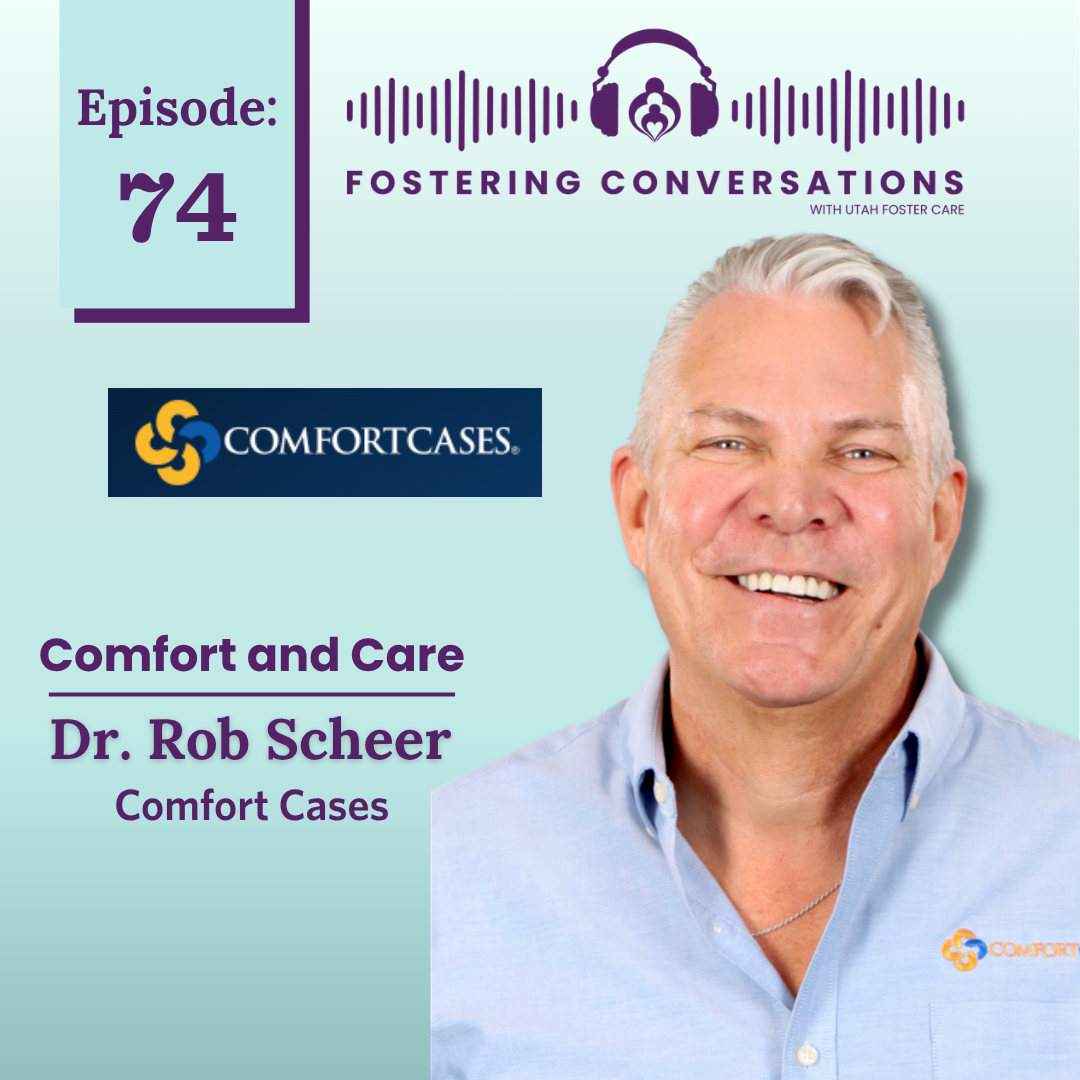
[00:00:00] Speaker A: On today's episode of Fostering Conversations, we're chatting with Rob Shear, who's the founder of Comfort Cases. He aged out of foster care and has since adopted five kids. Join us to listen more about his story.
This is Fostering Conversations with Utah Foster Care, where we have insightful conversations about parenting for bio foster, adopted or blended families to better understand the experiences we all face as families. Welcome to Fostering Conversations. I'm your host, Amy Smith. Today we have Ragh Shearer. He is a dad and founder of of Comfort Cases. Thanks for joining us, Rob.
[00:00:34] Speaker B: Amy, thank you so much for having me. I'm so excited about this conversation.
[00:00:37] Speaker A: Yes. So just start us off and telling us a little bit about your story and who you are.
[00:00:42] Speaker B: Yeah. The thing is that my story is probably not like many. I'm actually the youngest of 10 kids.
My mother had been married six times. We lived in Ivory Shelter. I don't remember pictures on the wall, Christmas trees, any of that stuff.
The saddest thing is, is for my mom, I don't once remember her saying, I love you, but I always remember the person she allowed to live in our house, and that was the person that we called my dad. I hear people all the time, Amy, talk about their family of origin. I hear people want to say, oh, look at all that bad they lived in. And by the way, my family was bad. My father would put cigarettes out on us. We bruises, scars. But they were my parents, right? And I loved them. I loved them. And I remember, by the way, I remember when I was 18 years old, I'd been in foster care since I was 12. I was handed a trash bag and carried it like so many kids do. And then when I walked into my home that I had been living at for years, and by the way, I had stopped even saying foster care. It was just, I was a kid just trying to get through life. And there it was, my trash bag, because it was my 18th birthday and I became homeless. And so that's how my journey started. And we see that so much. 22,000 kids in the United States will age out. That's an average we have right now. And we all know that 70% of those kids become homeless like me.
[00:02:08] Speaker A: So, yeah, it was interesting when I was getting to know you through the information that you sent over and this platform that you use for comfort cases.
The very first kid that came to my home was coming from another foster home that had disrupted. And I fully expected her to come prepared. Right? She had been in a foster home. She had been in the system for some time. But sure enough, she walked up with a black trash bag and it was speaking to me.
[00:02:33] Speaker B: It is beyond. And that's the thing that gets me, Amy, here at Comfort Cases. And by the way, I saw this need 14 years ago.
And at that point we'd adopted four of our five kids. And I adopt these kids out of foster care. They came carrying trash bags and the only thing I wanted to do was give them all the things I didn't have as a kid.
[00:02:52] Speaker A: Right.
[00:02:53] Speaker B: So for me, I was all about the material things. I put them in private schools, designer clothes. We traveled the world. My kids did not want for anything. But then I raised a bunch of privileged kids.
What I realized though, is how upsetting it is for the number of kids in foster care who continuously go from placement to placement and still carry a trash bag, who go from placement to placement without things of their own. And prime example, I said this to you off camera and I'm going to say it to everyone. I have five kids. Okay. My husband and I, 17 and a half years ago, decided to build our family through foster care. I grew up in the system. I was homeless.
I was everything the statistics said they would be. Okay. The difference between me and most kids is I chose not to have the system define me. I also chose that I wasn't going to blame the system, I was going to change the system. And so I went in that mindset. But when my children arrived in carrying trash bags and then realizing 14 years ago that we could make an impact by picking the low hanging fruit. And by the way, you pick your low hanging fruit, your tree grows taller.
And by giving kids the necessities on their first night. Okay, so you're a foster parent. You get it. You get that call at one o' clock in the morning for an emergency placement. And not all of us have wipes. Not all of us have baby lotion. Not all.
[00:04:19] Speaker A: Every size. Pajamas. Yes.
[00:04:21] Speaker B: Pajama size for that particular youngster. We all don't have that. So comfort cases, we want to give those foster parents all the essential items for their first night. Pajamas, all the toiletries, a book, a stuffy, a blankie.
[00:04:35] Speaker A: Yeah.
[00:04:36] Speaker B: What shocks me is that when I see kids go from placement to placement, Amy. And they still have a trash bag.
[00:04:42] Speaker A: I know.
[00:04:43] Speaker B: Given them a comfort case. We've actually given them comfort xls, which is our 32 inch duffel bag. But they're still with a trash bag.
[00:04:49] Speaker A: I know.
[00:04:50] Speaker B: Let me explain to you what the problem is. There's no accountability within Our foster care system?
No. And why there's not accountability because we don't have enough families. So if you start making the families that we have accountable now, we're going to lose families.
[00:05:06] Speaker A: I remember a little girl coming to us, like you say, at odd hours of the day. I swear I only got the calls at the odd hours.
And she was so excited to open that little bag and find the little toy and have some jammies that night. And I think people that haven't fostered don't fully grasp.
It seems small, it seems silly, but it's not.
[00:05:30] Speaker B: I. When we started comfort cases and we were deciding what we wanted to put in the cases, it was my son, Grayson. He was five years old. He's now 19. Yesterday actually, we were visiting a college and. But he said at the age of five, he said, daddy, we have to put a blankie in every case. And I remember saying to Grayson, grayson, these kids are not cold. He said, I know, daddy. He said, they wrap themselves up in their blankie. They know we love them.
[00:05:56] Speaker A: Exactly.
[00:05:56] Speaker B: I mean, you never a five year old. And he yotted. That's exactly what we want. We want to be loved. We want to know we matter. We're not disposable. And that's why I think it's so important that when children enter foster care, and by the way, when a kid enters foster care, we've already failed, okay? We've already failed in society. We have forgotten gotten what it's like to love thy neighbor. And when you love thy neighbor, this is how you're supposed to love thy neighbor.
When you see those kids outside at an ungodly hour and they're all disheveled and something's going on, don't call cps, walk over, knock on the door, look at the mom and say, hey, you want to talk?
Is there something I can do? I. And again, I'm not telling you not to write checks and. But just listening to someone, Amy, maybe she would say, you know what? I got this new job and I'm trying to get to work, but I don't have the money to pay for daycare and I've got to be gone for two hours before the kids get on the bus.
[00:06:59] Speaker A: Yeah.
[00:07:00] Speaker B: Ms. Sally, why can't you watch those kids for two hours so she can go to work? Amy, that's what I'm talking about. Where we fail society by not supporting each other.
[00:07:09] Speaker A: I always.
When I first entered the foster care system, world, not system. I didn't grow up in foster care, but as a Foster parent. It struck me that these are kids coming to strangers. I don't know these kids. And I think about if something happened to me and my husband and we and our kids needed to be somewhere. I have a really long list of people that could take them.
But we have kids in every county in America, every state across the world that have no one. They're landing on strangers doorsteps in the middle of the night. And that sad.
[00:07:47] Speaker B: It is so sad. And we fast forward 2019.
I'm a banker by trade, Amy. So when I age out of foster care, kids in foster care, by the way, we're only given three choices. That is it. Choice number one, we give up. Suicide rate in foster care is higher than we've ever seen. Choice number two, we, we give in. We do exactly what they expect of us. We commit the petty crimes, we fill the detention centers, or we take choice number three and that's give it all we got. And that's what I did. I joined the United States Navy. And by the way, I didn't join the Navy for any of your listeners or viewers. I joined the Navy because this boy was hungry. And I became a really successful businessman and I never looked back. I was like, me, that's not the way society should be. And in 2019, when I realized that it should not be about me, but more about my legacy. And my legacy is what you give and not what you take. I actually walked into a high school where I live and I told my story. A story about a 12 year old little boy who had been handed a trash bag, basically tried to define him. And about how that same boy decided to make sure that all the choices that the system gave him, he chose something different.
And yeah, and as I told my story, I saw a young boy in the audience getting emotional. And he actually walked up to me afterwards and handed me my memoir. And he said, Mr. Shear, will you sign this book? And I was like, of course. I was like, what's your name? And he said, alex. And I said, alex, tell me something about yourself. And he says, I had nothing to tell. And I was like, alex, we all have a story.
And he said, no, my story's like yours. I've been in foster care since I was five. I basically have been in and out of 11 homes, six schools, 18 years old, aging out, and he was going to be homeless. And I remember it hit me so hard.
And I remember even saying to the young man, I was like, listen, it doesn't have to go that way. And he was like, nope, I've fallen through the cracks of child welfare. And I looked over at the principal, she had a tear going down her eye, and she said, Mr. Shear, Alex has a 3.6.
Wow. And I was like, whoa. And I remember I handed him my business card, and I ended up having Alex to our home for dinner. And on that Saturday, and we end up going out to dinner. And I remember my. My son Tristan was 10, he's now 6, 17. And he said, alex, you can order anything off the menus, and my dads don't care. And he was like, I can order anything. And my. My kids were like, yeah. And my daughter was like, alex, haven't you been at Guapo's? And Alex was like, I don't remember last time somebody took me to a restaurant. Yeah, Amy, at that moment, I realized as a dad, I'd done my job. I saw the empathy flow out of my kid's eyes.
Went to Dave and Buster's, dropped Alex off at his foster parents house. And I get in the car and it's.
And one of my kids go, dad, we have to do something for Alex. I know. I said, I know, guys.
Dad just doesn't know what to do. And they were like, we have to bring him home. I was like, what?
And they were like, we have to bring him home. I looked at my husband. My husband and I have been together 21 years. I looked at my husband, my husband goes, what's one more? Oh, gosh, yes, my husband. Actually, him and I were the very first couple in the state of Maryland. But petition the courts to have a child from foster care live with us without a stipend.
[00:10:58] Speaker A: That's awesome.
[00:10:59] Speaker B: And the judge said to me, Mr. Scheer, why would you do this? And I said to the judge, as I say to every single one who listens and views this, every single child deserves a foundation. Every child deserves to know there's someone they're rooting them on. And every child deserves to know what it feels like to be loved unconditionally. I remember I looked at my son and he was crying, and he said, pops, you have changed my life. I said, no, buddy. I said, you've changed our lives. Yeah. He said, I only have one regret. I remember the judge said to me, Mr. Shear, what is your regret? And I said, I didn't get to walk him to kindergarten, but now I get to walk with him for the rest of his life. A year after that, we were in the height of pandemic, and our son walked up to my husband And I. And said, dada and Pops, will you please adopt me? I said, what? I said, you ain't going anywhere.
He said, no, I want the same last name as my sister and brothers and as you and Dada.
I called my adoption attorney the next week, and my husband, I legally adopted Alex. Our kids are now 25, 21, 19, 19, and 17.
Wow.
[00:12:03] Speaker A: That's awesome. And he was an adult by legal standards.
[00:12:08] Speaker B: Yes, it was an adult adoption. Very unusual, very unheard of. And for a kid at the age of 18 to find his forever family is something I didn't ever get to experience.
[00:12:22] Speaker A: Right.
[00:12:22] Speaker B: And all of these firsts that I've been going through with our kids and my kids, who, by the way, are understanding that dad's going through a lot of firsts and they're going through something that they don't have to worry about because they're breaking the cycle.
[00:12:37] Speaker A: It is amazing and sadly unusual to break that cycle.
And you have broken it. And now you're raising children that are breaking it. And that's the only way to fix this problem. Right? Is.
[00:12:50] Speaker B: But, you know, the sad. The. Sorry to cut you off, but the sad things is I look at my brothers and sisters, and they didn't make it.
[00:12:56] Speaker A: Which is more common.
[00:12:57] Speaker B: Yeah. You stick the F word in front of their names and you get all that. Teenage pregnancy, drug addiction, incarceration, all of the things. Things that come with that F word. And what I want people to know is that, first of all, kids come into a system because of a choice someone else made. Two, there is no such thing as a bad kid. It's only a kid that needs to be redirected.
[00:13:23] Speaker A: Right. And came from really hard circumstances.
[00:13:26] Speaker B: Yes. Understand that every single one of us fall, Amy. All of us fall. It all depends on how we get back up. I used to hear all the time the old people would say, oh, invest in those kids. You invest in their future. That's a bunch of lies. Elders would say that crap. That's lies. When you invest in a kid, you actually invest in my future and your future. There are leaders of tomorrow. Nelson Mandela said it so clearly. Each and every one of us in society are judged by the way we treat our children.
Kids in foster care, they don't belong to you, they don't belong to me. They belong to us. To us. So close to 400,000 kids belong to us. We should be ashamed.
[00:14:10] Speaker A: That is rough that there's that many kids in America that are in the foster care system.
[00:14:16] Speaker B: One kid every two minutes are averaging right now in the United States, 740 a day that are averaging entering our foster care system.
And when you're looking at the average age of seven, when you're looking at the fact that people need to understand that this is not a race thing because the majority of kids in foster care are white.
Let's understand, though, that in society we have a 26% ratio of black people and we have a 25% ratio of black kids in foster care now that we have a big issue with, but I want people to understand is that kids in foster care, they did not ask to be there, and so we have to do better.
[00:15:02] Speaker A: Something that I would love, if you're able to touch on, is why do you feel like you were able to become the person you've become versus your siblings who have really maybe all of them or some of them have fallen into the traditional statistics?
[00:15:16] Speaker B: Yeah, great question. Let's make sure everybody is clear. I did not wake up at the age of 18 and said, oh, I'm going to be that right. I let me tell you, I had four suicide attempts by the time I was 24.
[00:15:29] Speaker A: Wow.
[00:15:29] Speaker B: I had already been addicted to narcotics by the time I was 24. I was on my fourth suicide attempt. And I woke up in the hospital.
And I remember, I remember if it was yesterday. And I looked up at the ceiling and I said, you know what? You can't even get this, so you gotta have something bigger for me.
And I remember I got out of the hospital the next day or so, and immediately I went and found my parents grave. I hadn't been to my mother's grave, my mother. I'd left my parents when I was 12. I hadn't seen my mom or. But I found their grave. And by the way, there was no headstone, was just a little silver strip that the grave attendant helped me find. And it was 24 years old. And I dropped to my knees and I forgave my parents.
I forgave my mom for never protecting me. I forgave my dad for the abuse, for touching me where he shouldn't, for all that I went through. But what I reminded them is my forgiveness was not for them to rest easy. My was forgiveness was I needed to take the power back, Amy.
[00:16:41] Speaker A: Right.
[00:16:41] Speaker B: And that's exactly what I did. And that was the moment I didn't take another drug.
I did not have another suicide attempt. And my husband and I, we've been there, like I said, 21 years. My husband grew up separate, totally different than I did. Grew up in the Midwest parents, been married 50 some years. He is so well educated, has his master's, has so many degrees. I don't even know the difference between there and there. So for me it was all about that forgiveness and about really coming into my own, realizing that if I wanted a great future, I had to make that great future by the way I made it.
[00:17:17] Speaker A: Would you consider that? We've just, we've interviewed so many former foster youth and I find we're all
[00:17:22] Speaker B: coming out of the woodwork.
[00:17:23] Speaker A: By the way, we need it.
[00:17:26] Speaker B: Years ago when I, when my husband and I decided to adopt out of foster care, first of all, two white gay men living in D.C. 20 years ago and we ended up getting a call. We only wanted one kid, by the way, we wanted that little baby because we wanted to get the real expensive stroller and be those couples.
Instead they called and they had set of siblings and my husband was like, we will never split siblings up. So my daughter was 4, our son was 2. Both of them trash bags, nothing in the trash bag. Three months later, Amy, my two year old and my six month old arrived. So we had four kids in diapers all within three months. But we didn't know anybody. We didn't know gay people with kids. We didn't know people that had foster kids. We knew. So now to hear you say all the people that you're and people that I've interviewed on fostering change, I love it. I love that people are finally realizing we are here, we're not going anywhere. We are part of this society and you're going to hear our story because our story is what's the tapestry of America.
[00:18:36] Speaker A: It is. And it's, I think it's what so encouraging to current youth in care to think I can be like him, I can be like her, I can do this, I can age out. Unfortunately, I wish no kid aged out right. I wish every kid was adopted or got to go back to a healthy family. But I just think, man, it's so
[00:18:58] Speaker B: many more opportunities here at Comfort Cases we give out scholarships to kids who are aging out of foster care. By the way, they can do higher education.
We truly make sure we look at their whole wraparound, what they need. Again, this is our responsibility.
I used to always think that it was all about all the money I made and all of that and everything. And it's not. It's truly about our dash. Each and every one are given one. The year we're born, our dash, the year we die. Make our dash count. And something that I think People need to understand is that we've all been taught that the world goes around on an axle, but that's not true. The world actually goes around by the doers that push it every single day. So your viewers, your listeners, they need to understand, wake up in the morning and be a doer.
[00:19:46] Speaker A: Yeah.
[00:19:47] Speaker B: And by the way, doesn't matter what you do. Doesn't matter. Not everybody, as long as it's good. Exactly, exactly. But not everybody has a passion for kids like you and I.
[00:19:57] Speaker A: Absolutely, absolutely.
[00:19:58] Speaker B: So I just want them to do, do.
[00:20:02] Speaker A: I always think it's so funny or tangent, but the idea of success. So many people think being successful is being rich or having a nice house. And to me that is success is being a contributing member to society to care for others, whether it's children or animals or working at Walmart, working at a high end bank. There are so many places that we are needed. And if you can contribute where you have a passion, that's what we need.
[00:20:29] Speaker B: You know, I totally agree with you 100% on that and I'm just like I said, thank you. I'm so happy that you've given us this platform. Wait, Utah is definitely doing some things that are. Yeah. And let's all understand the foster care system was created to do exactly what it's doing and that's basically making money on the backs of kids. We are a system that has to really relook at ourselves. And why I say that is because if we can take and give a stranger a stipend, okay, we can take part of that money and put it in an interest bearing savings account for these young people for when they do age out. Because as you said, not all of these kids are getting their forever family and not all of these kids are having that net that they all truly deserve. I look at my son Alex, he's 25, he's finishing his junior year in college and he came to us at 18. But I remember when he was about 20 years old, we had gotten him a car, he'd gone and he had locked his keys in the car. Typical teenage thing done before.
And I remember he called me and he was like, pops, I locked my keys in the car. And of course I did the dad thing. You give the little lecture and then
[00:21:42] Speaker A: you solve the problem and you solve the problem.
[00:21:45] Speaker B: Solved the problem. I called aaa. We got the keys. My son got his keys. He got to come, he got back home.
But what, what I'm the. My whole reason for this is that he had his dad's.
[00:21:58] Speaker A: He had someone to call his dad's.
[00:22:00] Speaker B: And I was able to pay that $80.
[00:22:03] Speaker A: Right.
[00:22:03] Speaker B: Those kids that are aging out, Amy, with no net.
[00:22:06] Speaker A: I know.
[00:22:07] Speaker B: Have $80.
Yeah. Foster care. I didn't even have the $30 to rent the cap and gown. So these kids have nothing. We can take a portion of that money and put it in an interest bearing savings account. And by the way, I do not mean write them a check. At 18, I have teenagers and manage money, but at least I have a net for them. But also, I want your listeners to understand that our community, it is not our zip code. Okay? Our community is our human race. So what affects me in my little town of Darnstown, Maryland, affects you in Salt Lake City, affects people in Phoenix, Arizona. It affects each and every one of us. And that's what we must understand is that our forefathers, they actually built communities for one reason. And it wasn't for our bushes to match. It was for us to take care of each other.
[00:22:58] Speaker A: Absolutely. And foster care is the epitome of taking care of each other. Or the lack thereof.
[00:23:03] Speaker B: The lack thereof.
[00:23:04] Speaker A: Lack thereof starts the cycle. I would love for you we're the podcasts always go by so fast when we're traveling. But I would love for you to just share in the last few minutes what types of resources Comfort Cases offers? Where what can foster parents reach out and find? What can kids in care reach out and find kids that are aging out? What are you offering? Where can people find these resources?
[00:23:26] Speaker B: I truly do believe that foster care is a community and we're all part of that community. And I also remind all the nonprofits that are listening, and I said this 14 years ago when Comfort Cases was born, is that I've never in my life been in the nonprofit world. I come from the dot com world. We're takers. And to be in the dot org world where we're supposed to be givers, I'm shocked how we do not work well in the sandbox. So for all you nonprofits, reach out to me because I would love to elevate you as nonprofit because that's what we should do. But if you are aging out of foster care, if you're part of the foster care community, at Comfort Cases, we have lots of support. We offer mentorships, scholarships for whether you're doing trade school, whether you're doing a college, by the way, you could currently be in college right now and still apply for one of our scholarships. Also, we do give these backpacks. Our backpacks are from birth up to the age of 21. For all of our foster care agencies go to comfortcases.org you can order those cases from birth up to the age of 21. You can choose the sizes. Our cases have everything from pajamas to girls feminine products to deodorant. We truly do know how to embrace our young people again from birth up to the age of 21. But what I really love is nine years ago, Reese and I realized that trash bag was not being eliminated. So I went door knocking and ended up getting a meeting with Briggs and Riley. And Briggs and Riley is the leading luxury luggage brand in the world.
[00:24:56] Speaker A: World.
[00:24:56] Speaker B: They are the only luggage brand that actually has a lifetime warranty. And when I got a meeting with them, I told my story. The story of a 12 year old boy carrying a trash bag. When Richard asked me what I wanted, I said I really need a piece of luggage that by the way, doesn't take up room because social workers don't have room. I hear that all the time. I said I need it to be durable. And so it took about four months for Briggs and Riley to do it. But they designed this for me. This is a Comfort XL. It is a 32 inch duffel bag. My Bernese mountain dog could fit in there.
[00:25:30] Speaker A: Love to see that.
[00:25:32] Speaker B: $19.
I get them for 10 bucks a piece and I've given over 190,000 of them away.
[00:25:39] Speaker A: That's amazing.
[00:25:40] Speaker B: By the way, they're designed to fold up the size of a book because they can stack in your office and you can't tell me you don't have space. So again, do me a favor, reach out to comfortcases.org or email
[email protected] and be a part of this wave because it's getting big.
[00:25:55] Speaker A: I love that. Those are amazing things. And yes, I've heard the exact same thing from caseworkers, police officers, cps, whoever's pulling those kids from the home. They can fit a box of trash bags, but they can't fit other things. But I'm pretty sure they could fit a couple of those.
[00:26:07] Speaker B: And by the way, this comes in a box of 25. Fits perfectly. And let's also real quick, and I know we got to go, but no social worker wants to grab a trash.
[00:26:17] Speaker A: Absolutely.
[00:26:18] Speaker B: Okay. And that's exactly why we invented these. Because this is they can have these. And by the way, the state can pay 10 bucks a piece to invest in our young kids. Okay.
[00:26:29] Speaker A: Or local community members are always happy to donate. That's a great way.
[00:26:33] Speaker B: If the states would contact me. I give them this and they get a Comfort xl and they like, come on, I'm not.
Again. At the end of the day, we all have an opportunity to make tomorrow better than it is today. And, Amy, that's what you guys are doing. So thank you.
[00:26:47] Speaker A: No, thank you so much for your time, for sharing a bit of your story, and for the good that you're doing for foster youth and care. It really is amazing and so appreciated. So thank you.
[00:26:56] Speaker B: Thank you. Take care.
[00:26:57] Speaker A: Thank you for joining us on Fostering Conversations.
This has been Fostering Conversations with Utah Foster Care. Thank you for joining us. For more information, go to www.utahfostercare.org. we'll see you next time.