Episode 70

April 07, 2026

00:25:47

Ep 70: Still Standing

Hosted by

Amy Smith
Ep 70: Still Standing
Fostering Conversations with Utah Foster Care
Ep 70: Still Standing

Apr 07 2026 | 00:25:47

/

Show Notes

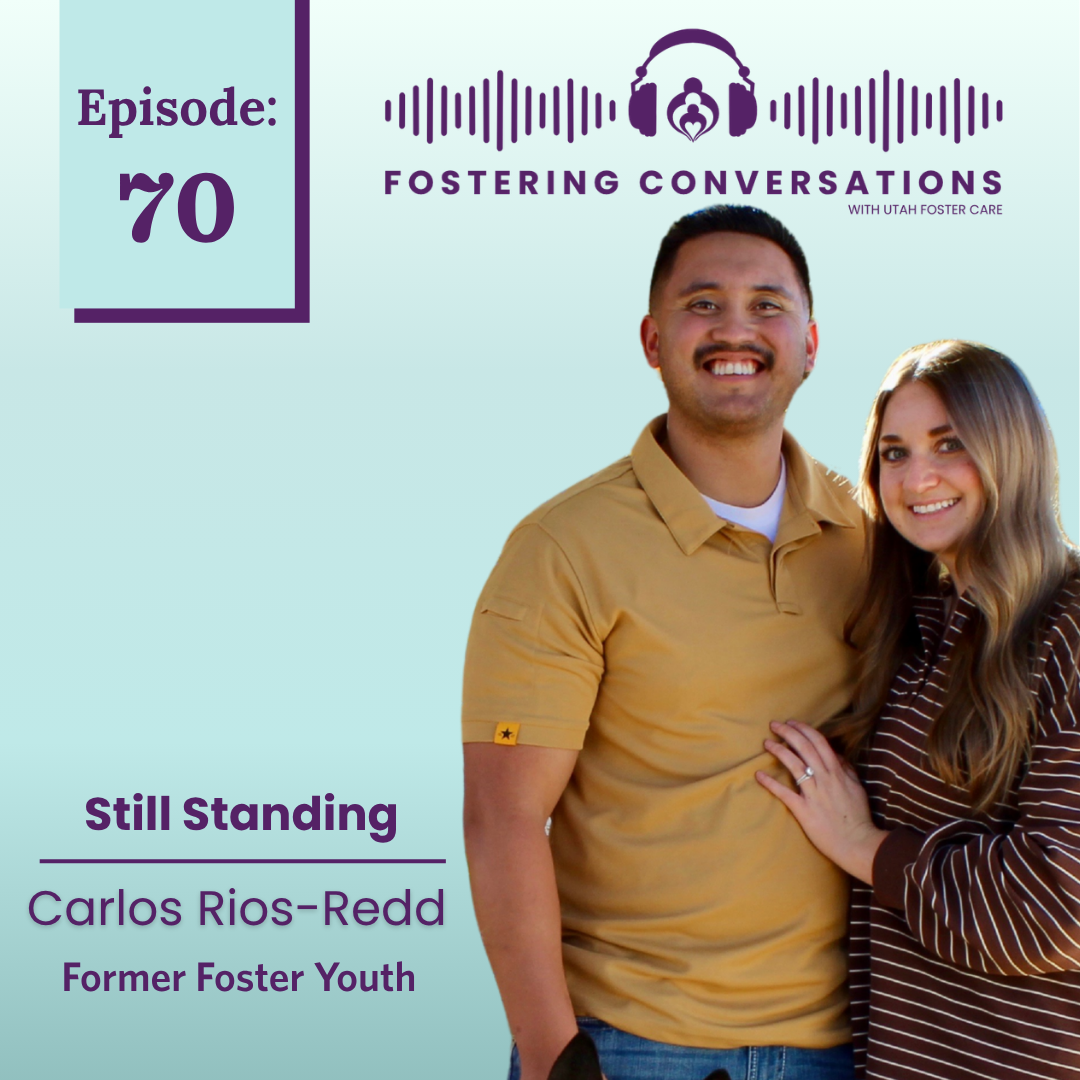
In this powerful episode of Fostering Conversations, host Amy Smith sits down with former foster youth Carlos Rios Redd to talk about lived experience in foster care, sibling separation, adoption disruption, resilience, and hope.

Carlos entered foster care as a baby, lived in more than ten homes, and experienced three adoptions. Despite repeated trauma and instability, Carlos shares how relationships, faith, and supportive families helped shape the life he leads today. Now married and working as a K9 handler with the Utah Highway Patrol, Carlos reflects on how growing up in foster care influenced his compassion, maturity, and commitment to service. His story offers meaningful insight for foster parents, youth currently in care, and professionals who work within the child welfare system.

In this episode, we discuss:

  • What it is like to grow up in foster care and experience multiple adoptions
  • The impact of sibling separation and staying connected
  • Reconnecting with biological siblings after years apart
  • Being a permanent child in a fostering household
  • Resilience, healing, and allowing yourself to be loved
  • Advice for youth currently in foster care
  • Why maintaining relationships matters long after placements end
Carlos speaks honestly about trauma without bitterness and shares why he believes connection is one of the most powerful tools for healing.

Resources mentioned in this episode:

If you are a foster parent, considering fostering, or supporting youth in care, this episode offers perspective that is both grounding and hopeful.

Transcript;

I reformatted the transcript so the sentences flow correctly, broken lines are fixed, speakers start on new lines, and long sections are split into readable paragraphs for WordPress. I did not intentionally change wording—only line breaks and paragraph structure.

Speaker: Join us for one of the most important aspects of foster care, former foster youth. Today we talk with Carlos who has gone through multiple homes and multiple adoption, and now he’s thriving.

Amy: Welcome to Fostering Conversations. I’m your host, Amy Smith. Today we have a former foster youth, Carlos Rios-Redd. Thanks for being with us today, Carlos.

Carlos: thank you for the invitation. Glad to be here.

Amy: Yeah, we’re so excited to chat with you. I think this is one of the most important sides of foster care to discuss is the lived experience. So would you just introduce yourself and tell us a little bit about your story?

Carlos: My name’s Carlos Rios-Redd shred. I grew up in foster care through the system about at a year old, and then lived through, 10 homes within 10 years and been adopted three different times.

And, I guess left the system through adoption at the age of 14, but really never left because we always had kids coming into our home as well. So I was able to see both sides of the spectrum on, on the foster care system.

Amy: Yeah. So you’ve been, had the lived experience and also had then youth come into your home as the permanent sibling, so that’s awesome.

So tell us a little bit about, I think it’s very unusual and honestly unfortunate that you were adopted three different times. Are you able to tell us a little bit about that?

Carlos: Sure. Yeah. So the first adoption was coming from California to Utah to Blanding where our family brought us over. And we were with them for about two years and there was a lot of abuse that happened within the home.

And one day they decided that they didn’t want us anymore, my brother and I, and left us at the DCFS office. Our caseworker came in and said, Hey, we gotta find you a home by the end of the day for you guys to move into. We’re gonna go gather your things because these parents don’t want you at the home anymore. So we’re gonna try to figure things out.

Amy: adopted at that

Yeah.

Carlos: Legally adopted. It was about two years with the so we made it from.

it was about 2005 when we moved over to Blanding here in Utah.

Amy: And then Okay.

Carlos: it was

Amy: 2007.

So then what did that look like? Do you remember being at that? Do, you were young, but do you remember being at that office or do you

Carlos: remember I do.

Yeah. So specifically that day, the office, they have a like a child’s room where they have the TV and the toys or whatever, and our caseworker just said, Hey, go in here, we’re gonna talk with your parents.

And in my head, it was one of just general meetings that they have after adoption just to make sure things are going good. And then the next thing you know, we get told we are moving to a different house.

Amy: Holy.

Carlos: cow.

Amy: then you guys go to another foster home?

Carlos: Yep. We go through another foster home and then another foster home. And then we landed in a place where we were there for about two and a half years.

And that was probably the first time ever felt that a family loved my brother and I. And we got really close with them.

And then unfortunately, the judge said, you’re taking too much time with these kids and we’re gonna remove them and put ’em in a different home.

Amy: Oh my goodness. Okay. So that one wasn’t the foster family’s

Carlos: No, that was the judge’s decision.

Amy: Wow,

Carlos: Yeah, and to my understanding is that it was just because the parents wanted to do a guardianship instead of a full adoption and the judge didn’t like that idea and so they removed us from the home.

Amy: Oh my goodness. Okay, so then you’ve reentered foster care again.

Carlos: So then we moved to a different home, which brought us up to Brigham City from the south east corner. So totally opposite ends of the state.

Amy: Yeah.

Carlos: Yes. We were only there for six months and then things weren’t going well there.

Amy: They did?

Carlos: No, it was very quick on how they did it and came and picked us up and brought us back down to Blanding after the six months.

Amy: Holy cow. And is that where your permanent home?

Carlos: No, that, No.

Amy: oh my gosh.

Carlos: And so then there was another home after that, which was with a previous family that we, or he had been with.

Amy: Okay.

Carlos: So we were familiar with them. And then came our second adoptive family. Which I, at the time was really good friends with one of their kids.

Amy: Okay.

Carlos: Okay. and they’re good people. So this isn’t anything to say they’re bad ’cause they’re not. Almost everyone that I’ve ever lived with, I am on very good terms with.

Amy: That’s amazing.

Carlos: So we went to their home and we’re with them. how old was I? I was probably about, I think I was 10.

And we were with them for maybe a year to a year and a half, somewhere around there. And then they had the idea to reconnect us with our family in California.

Amy: Okay.

Carlos: And so we went down there for Christmas, I don’t recall the year, but for Christmas, and spent Christmas with them and was able to see my sister and my mom, and reconnect that way.

And then they said, we would like for you guys to spend the rest of the school year there and we’ll come back in May, June, whenever the school year ends and bring you back home. Just so that way we could just have that relationship with your biological family.

Amy: Yeah.

Carlos: And then things would’ve fallen out with that, with kind of some financial support or just in general just talking with them.

Amy: Yeah.

Carlos: And it’s sparked kind of an investigation or a curiosity with my brother and he got into my sister’s phone and saw messages that patients have seen.

Yeah, that caused a lot of legal trouble for that family.

Amy: For the adoptive family?

Carlos: Yes. For the adoptive family. And they were getting charged with child neglect and child abandonment, because there was really no intention for them to come back and get us.

Amy: Sure.

Carlos: Which again, I haven’t been able to see the fully disclosed like the documents of the court which I’ve been trying to get, but the GRAMA request isn’t.

Amy: I’m sure.

Carlos: They’re being hard with that.

But just speaking with several people was I don’t think their intentions were bad. I think the intentions was like, let’s get these kids back with their family if they’d like.

But with the charges going on and them potentially facing jail time, my now family said these are good people. Don’t charge them. We’ll take the kids. Drop the charges.

And that’s what they did.

They dropped the charges and everything with that adoptive family and my brother, they came and picked us up June 4th of 2012, 6 in the morning.

I remember I was staying with my sister. Six in the morning they picked us up and we drove all the way back in a day to Blanding and moved in with the Reds now, my adoptive family.

And then after a little bit my brother returned to a previous family that we had lived with and was adopted by them. And so his last name is Black and my last name is Redd.

Amy: That worked out.

Carlos: it’s funny. I like to tell that. So a lot of stuff happened within all those families that we lived in. And again, like I said, I don’t have no hard feelings against any of the families that I’ve ever lived with.

Amy: Yeah.

Carlos: Which is really incredible because you really shouldn’t have been bounced around that much.

Amy: Yeah. But unfortunately it is your life experience.

Carlos: Yeah. I mean honestly, looking back, I would not give it up because I think it’s made me to who I am today.

Amy: That’s amazing. That is an incredible perspective.

So tell us a little bit about what it was like being with your biological family. How did that, like how was reconnecting with them initially when you were 10 or so years old?

Carlos: It was weird to start off with.

Amy: Because really they’re strangers, right?

Carlos: Yeah. The last time I saw them was when I was five.

I’m the baby of seven. Out of biological siblings I have half siblings and a couple full siblings. And I never really got reconnected with the two older siblings very much. I don’t, and I still don’t really know them very well.

But the others I’m very close with and I never really look at the ones that have a different parent than I as half. They’re all like, these are full siblings because I know I’ve known them now and been able to reconnect with them so well that I don’t see it that way.

My sister, it was a little bit awkward at first. Trying to figure out like, I know you’re my sister, but I don’t really know you.

After a little bit within that six months we were able to get to a point where it’s like, yeah this is really good. Even with her boyfriend, now husband, I’ve known him since almost just as long as I’ve known her now.

So it’s really good. We function as a good family I think and we try to see each other when we can and talk on almost a daily basis.

Amy: So were all of the biological siblings removed, or just you and your brother?

Carlos: So all of us were.

Amy: Okay.

Carlos: Except for the older two.

Amy: Okay.

Carlos: Some of them came to Utah and some did not.

Amy: Okay.

Carlos: Yeah. So my brother and I came to Utah. The other siblings were either put into a group home because they were older.

Amy: Okay.

Carlos: My two older sisters were put into group homes.

And then the one home in California that we stayed in, that was the sister that I was just talking about and my brother.

Then when my brother and I were adopted they only took me and him to Utah. They tried to bring the other siblings over to see if that would work, but it didn’t end up working.

Amy: Yeah. What I’m really amazed by is that you guys have all reconnected. That’s a big family and to reconnect is really impressive.

So who would you credit that to? Is it you guys now as adults? Is it these adoptive families? Like how did you guys reconnect?

Carlos: I think the second adoptive family that sent us back probably gets some of that credit.

Because without them doing what they did, it may not have ever happened until later on. And you never know how reactions would’ve been later on if it was a different family that would’ve reconnected us.

And it’s funny, speaking of reconnection, this last Thanksgiving was the first time in over 20 years that all of us—except for the older two—had been together under the same roof.

Amy: That is wild.

Carlos: And so Thanksgiving was the first time.

Amy: And how was it?

Carlos: It was great. Everyone was smiling, having a good time. You could just feel the love in the air. It was great.

Amy: Yeah. And is everybody healthy and functioning and thriving?

Carlos: For the most part, yeah. I think some obviously struggle more than others, but for the most part everyone seems to be doing really good.

Amy: That is so incredible to me.

I have adopted kids and I know my kids have half siblings. We’ve never had that opportunity to meet those kids or have that relationship. I think that is really unusual and quite a gift that you’ve been able to have that.

Carlos: Yeah, it’s awesome. I talk to almost all of them all the time. My brother Gio actually lives in Provo, so he lives about 10 minutes from me.

Amy: That is so cool.

So you and your brother were originally together for almost all of those moves?

Carlos: Yeah, pretty much everything.

Amy: And then the final move got split.

Carlos: Yeah.

Amy: What was that experience like for you?

Carlos: Although we were in the same town, I remember the court day pretty good. It felt like my heart was torn out of my chest.

Amy: Yeah.

Carlos: I was sitting in the back row of the courtroom, bawling my eyes out because it felt like I just lost my brother forever.

I think it was just a 13- or 14-year-old kid being dramatic, but it was pretty hard.

Fortunately we were in the same town. I could drive to his house and it would take me 10 minutes.

The families did things together throughout the week or months. Then eventually he moved and I moved, and now here we are again living about 10 minutes apart.

My wife gets mad sometimes because I want to do things with my brother more than sometimes with her.

Amy: That’s amazing.

Carlos: I love it. He’s one of my best friends because he’s experienced that with me. He was a protector.

Amy: What would you tell people—maybe kids that are in foster care or families that are fostering—if siblings have to be split up?

Carlos: That’s a hard question. I don’t know if I necessarily have advice, but I would tell them it’s going to be okay.

As long as they do their part to keep in contact and show that they want to still be part of each other’s lives, it’s going to be okay.

If they get removed I don’t think they need to cut off all communication. The advice would be to continue the relationship.

Amy: I love that. I think that is a huge part of foster care.

Your story is a really good example of why it’s so important. You have a huge network of biological, adoptive, and family connections because people kept the relationships open for you.

Okay, so tell us a little bit about what you’re doing now as an adult. You’re married—what does your life look like now?

Carlos: I currently work for Highway Patrol as a canine handler.

The dog that I have is a Belgian Malinois, four years old, and he helps with detection of narcotics and hopefully at some point for apprehension if needed.

I’ve been doing that for almost four years and it’s been a blast.

I’ve definitely experienced some things that even a 20-year veteran hasn’t experienced.

I had an accident when I was about a year and a half on the job where I took a car head-on going the wrong way.

After I came back to work I got into the canine program. I’ve always been interested in interdiction and narcotics investigations.

By God’s grace I was able to get into it.

I’ve been recognized by the NAACP, by Governor Cox, received a Purple Heart for that accident, and also a Medal of Honor recipient from Orem Fire—the first time it was given to someone outside of their organization.

Amy: Wow.

Do you feel like your life experiences growing up influenced your decision to go into this line of work?

Carlos: A hundred percent.

I couldn’t pinpoint exactly what it is, but I believe the way I grew up influenced what I do now. It gives me a better perspective on how to do the job and be more compassionate when needed.

But also knowing when there needs to be a boundary.

Growing up in foster care and the experiences I had made me grow up fast.

Amy: For sure.

Carlos: I’ve been told a lot that I have the maturity of someone older than 25. I don’t always feel that way, but maybe it’s true.

Amy: You’ve experienced so much.

How do you think you are so resilient? You have experienced things that most people haven’t and things that no one should experience.

Carlos: I have a couple reasons.

The first one is probably my relationship with God. I’m not saying everyone has to believe in God, but I believe something guides people.

For me it’s my relationship with God and knowing He guided my life to where I needed to be at certain times.

The second reason would be my family—my mom and my dad. They’re good examples of resilient people who have gone through a lot.

Amy: That’s amazing.

Tell us what it was like being a permanent sibling while your family continued to foster kids.

Carlos: Sometimes there was jealousy because when you’re the foster kid you get a lot of attention. Then suddenly there are other kids in the house and your parents are focusing on them.

But it also helped me understand the struggles those kids were going through.

I could connect with them easier than someone who had never experienced foster care.

Sometimes I even sided with the foster kids because I understood exactly what they were going through.

Amy: That’s a really interesting perspective.

Carlos: There was a specific instance where one of the foster kids got into a physical altercation with one of my brothers and I stepped in and defended the kid in care.

But everything smoothed out and we’re all good.

Amy: What was it like when kids would reunify with their families?

Carlos: I was happy for them.

I already had a relationship with my family, so I wanted them to have that too. I wished them well.

Amy: Have you kept in touch with any of them?

Carlos: Yes and no. My parents have more than I have.

Amy: What would you tell youth that are currently in foster care?

Carlos: A mantra I keep for myself is that through pain and suffering there is light at the end of the tunnel.

What you’re going through now can shape you into a better person if you face it head on. One day you’ll be able to help someone else.

It can make you more understanding, empathetic, and less judgmental.

Just keep going. There will be better days ahead.

Amy: Did therapy help you?

Carlos: I hated therapy. I refused to go.

I felt like many therapists were just there to be there.

What helped me most was allowing myself to feel the love of the parents and siblings around me.

Sometimes kids don’t get that luxury, but there’s usually someone in the family you can connect with.

I would encourage kids to find that connection.

For example, one family we lived with for two and a half years still considers us family.

When the mom passed away we were put on her headstone as one of her kids.

Amy: Wow.

Carlos: We still go to family functions with them.

So I would encourage kids to find one or two people they can build a real connection with. A lot of healing can come from that.

Amy: I love that.

Kids do have to allow themselves to be loved, which is really hard when you’ve been hurt so many times.

Carlos: Yeah, I still struggle with that.

Amy: Thank you so much for joining us today and sharing your story. I know our listeners will really appreciate it.

Carlos: Of course. Feel free to give my information to anyone. I’m always willing to talk or try to help someone out.

Amy: That’s amazing. Thank you so much, Carlos.

If you want to learn more about foster care, head over to www.utahfostercare.org.


View Full Transcript

Episode Transcript

[00:00:00] Speaker A: Join us for one of the most important aspects of foster care. Former foster youth. Today we talk with Carlos, who has gone through multiple homes and multiple adoptions, and now he's thriving. This is Fostering Conversations with Utah Foster Care, where we have insightful conversations about parenting for bio foster, adopted or blended families to better understand the experiences we all face as families. Welcome to Fostering Conversations. I'm your host, Amy Smith. Today we have a former foster youth, Carlos Rios. [00:00:39] Speaker B: Red. [00:00:40] Speaker A: Thanks for being with us today, Carlos. [00:00:41] Speaker B: Well, thank you for the invitation. Glad to be here. [00:00:44] Speaker A: Yeah. We're so excited to chat with you. I think this is one of the most important sides of foster care to discuss is the lived experience. So would you just introduce yourself and tell us a little bit about your story? [00:00:54] Speaker B: My name is Carlos Joe Shred. I grew up in foster care, entered the system about at a year old, and then lived through 10 homes within 10 years and been adopted three different times. And I guess left the system through adoption at the age of 14, but really never left because we always had kids coming into our home as well. So I was able to see both sides of the spectrum on the foster care system. [00:01:19] Speaker A: Yeah. So you've been. You've had the lived experience, and you've also had then youth come into your home as the permanent sibling. So that's awesome. So tell us a little bit about. I think it's very unusual and honestly unfortunate that you were adopted three different times. Are you able to tell us a little bit about that? [00:01:36] Speaker B: Sure. Yeah. So the first adoption was coming from California to Utah to Blinding, where a family brought us over, and we were with them for about two years, and there was a lot of abuse that happened within the home. And one day they decided that they didn't want us anymore. My brother and I and left us at the DCFS office. And our caseworker came in and said, hey, we gotta find you a home by the end of the day for you guys to move into. We're gonna go gather your things because these parents don't want you at the home anymore. So we're gonna try to figure things out. [00:02:10] Speaker A: And you had been legally adopted at that point? [00:02:12] Speaker B: Yeah, legally adopted. It was about two years with the family. So we made it from. It was about 2005 when we moved over to Blanding here in Utah, and then it was 2007. [00:02:23] Speaker A: So then what did that look like? Do you remember being at that. You were young, but do you remember being at that office or do you remember any of that? [00:02:30] Speaker B: Yeah, I do. Yeah. So Specifically that day, the office, they have a. Like a child's room where they have the TV and the toys or whatever. Our caseworker just said, hey, go in here. We're going to talk with your parents. And in my head, it was one of just the general meetings that they have after adoption just to make sure things are going good. And then the next thing you know, we get told we are moving to a different house. [00:02:55] Speaker A: Holy cow. So then you guys go to another foster home? [00:02:59] Speaker B: Yep. We go through another foster home and then another foster home, and then we landed in a place where we were there for about two and a half years. And that was probably the first time I ever felt that a family loved my brother and I. And we got really close with them. And then, unfortunately, the judge said, you're taking too much time with these kids and we're going to remove them and put them in a different home. [00:03:23] Speaker A: Oh, my goodness. Okay. So that one wasn't the foster family's decision? [00:03:26] Speaker B: No, that was the judge's decision. Oh, yeah. And to my understanding is that it was just because the parents wanted to do a guardianship instead of a full adoption, and the judge didn't like that idea, and so they removed us from home. [00:03:40] Speaker A: Oh, my goodness. Okay. So then you've reentered foster care again. [00:03:44] Speaker B: So then we moved to a different home, which brought us up to Brigham City from the southeast corner, so totally opposite ends of the state. We were only there for six months, and then things weren't going well there. They didn't know. It was very quick on how they did it and came and picked us up and brought us back down to planning after the six months. [00:04:04] Speaker A: Holy cow. And is that where your permanent home? [00:04:07] Speaker B: No. No. [00:04:08] Speaker A: Oh, my gosh. Okay. [00:04:09] Speaker B: And so then there was another home after that which was with a previous family that we already had been with. [00:04:15] Speaker A: Okay. [00:04:16] Speaker B: So we were familiar with them. And then came our second adoptive family, which I, at the time was really good friends with one of their kids. [00:04:24] Speaker A: Okay. [00:04:25] Speaker B: And they're good people. So this isn't anything to say they're bad because they're not. Almost everyone that I've ever lived with I'm on very good terms with. That's amazing. So we went to their home, and we're with them. How old was I? I was probably about. I think I was 10. [00:04:40] Speaker A: Okay. [00:04:41] Speaker B: And we're with them for maybe a year to a year and a half somewhere around there. And then they had the idea to reconnect us with our family in California. [00:04:51] Speaker A: Okay. [00:04:52] Speaker B: And so we Went down there for Christmas. I don't know what to call it a year, but for Christmas. And spent Christmas with them and was able to see my sister, my mom, and reconnect that way. [00:05:03] Speaker A: Okay. [00:05:03] Speaker B: And then they said, we would like for you guys to spend the rest of the school. The rest of the school year there and we'll come back in May, June, whenever the school year ends, and then bring you back home. [00:05:15] Speaker A: Yeah. [00:05:16] Speaker B: Just to. So that way we could just have that. [00:05:18] Speaker A: Facilitate that relationship with your biological family. [00:05:21] Speaker B: And then things were falling out with that. With kind of some financial support or just in general. Just talking with them. [00:05:30] Speaker A: Yeah. [00:05:30] Speaker B: And it sparked kind of an investigation or a curiosity with my brother. And he got into my sister's phone and saw messages that he shouldn't have seen. [00:05:41] Speaker A: Yeah. [00:05:42] Speaker B: That caused a lot of legal trouble for that family. [00:05:46] Speaker A: For the adoptive family. [00:05:47] Speaker B: Yes, for the adoptive family. And they were getting charged with child neglect and child abandonment because there was really no intention for them to come back and get us shooting. Which again, I haven't been able to see the fully disclosed, like the documents in the court, which I've been trying to get. But the grammar request isn't. It's. I'm sure, yeah, they're being hard with that. But just speaking with several people, it was. I don't think their intentions were bad. I think they. The intentions was like, let's get these kids back with their family if they'd like. But with the charges going on and them potentially facing jail time, my now family, these are good people. Don't charge them. We'll take the kids, drop charges. And that's what they did. So they dropped the charges and everything with that adoptive family and my brother. They came and picked us up. June 4th of 2012, 6 in the morning. I remember I was staying with my sister. Six in the morning, they picked us up and we drove all the way back in a day to blinding and moved in with the Reds now my adoptive family. And after a little bit, my brother returned to a previous family that we had lived with and was adopted by them. And so his last name is Black and my last name was Red. [00:06:57] Speaker A: Well, that worked out. [00:06:58] Speaker B: So that's funny. I like that. So a lot of stuff happened within all those families that we lived in, lived in. And again, like I said, I don't have no hard feelings against any of the families that I've ever lived with. [00:07:08] Speaker A: Yeah. Which is really incredible because you really shouldn't have been bounced around that much. But unfortunately, it is your life experience. [00:07:16] Speaker B: Yeah. I mean, honestly, looking back, I would not give it up because I think it's made me to who I am today. [00:07:21] Speaker A: That's amazing. That is an incredible perspective. So tell us a little bit about what it was like being with your biological family. How did that. Like, how was reconnecting with them initially when you were 10 or so years old? [00:07:35] Speaker B: It was weird to start off with [00:07:37] Speaker A: because really they're strangers. Right. [00:07:39] Speaker B: Yeah. The last time I saw them was when I was five. I'm a baby of. Or the baby of seven. [00:07:45] Speaker A: Right. [00:07:45] Speaker B: The biological half. Half siblings and a couple full siblings. And I never really got reconnected. The two older siblings, very much I don't. And I still don't really know them very well. But the others I am very close with, and I never really look at the ones that have a different parent than I as half. They're all like, these are full siblings because I've known them now and been able to reconnect with them so well that I don't see it that way. My sister, it was a little bit awkward. Right. Trying to figure out, like, I know you're my sister, but I haven't really. But I don't really know. After a little bit within that six months, we were able to get to a point where it's. Yeah, this is really good. Even with her boyfriend, now husband, I've known him since almost. Just as long as I've known her now. And so it's really good. We function as a good family, I think, and we try to see each other when we can and talk on almost a daily basis. [00:08:38] Speaker A: Yeah. So were all of the biological siblings removed or just you and your brother? [00:08:43] Speaker B: So all of us were okay. [00:08:45] Speaker A: Except for the older two came to Utah and some of you did not. [00:08:49] Speaker B: Yeah. So my brother and I came to Utah. The other siblings, they were either put into a group home. [00:08:58] Speaker A: Okay. Because they were older. [00:08:59] Speaker B: Yeah. So my. My two older sisters were put into group homes. And then in the one home in California that we stayed in that we were at was the sister that I was just talking about and my brother. [00:09:13] Speaker A: Okay. [00:09:13] Speaker B: And then when we. My brother and I were adopted, they only took me and him to. To Utah. They tried to bring the other siblings over to see if that would work, but. [00:09:23] Speaker A: Right. [00:09:23] Speaker B: It didn't end up working. Yeah. [00:09:25] Speaker A: What I'm really amazed by is that you guys have all reconnected. That's a big family. And to reconnect is really impressive. So how. Who would you credit that to? Is it you guys now as adults Is it these adoptive families? Like, how did you guys reconnect? [00:09:41] Speaker B: I think the family, the second adoptive family is. That started it would probably get some of that credit because without them doing what they did, it may not have ever happened until later on. And I don't think. You never know how reactions would have been later on if it was a different family that would have reconnected us. And it's funny, speaking of the reconnection, is this last Thanksgiving was the first time in over 20 years that all of us except for the older two, because we're not really in good relationship, I guess, with the oldest two, but the rest was the first time in over 20 years that we'd ever been together under the same roof. [00:10:18] Speaker A: That is wild. [00:10:19] Speaker B: And so Thanksgiving was. That was a good. Was a good time. [00:10:22] Speaker A: Tell us about it. [00:10:23] Speaker B: It was great. Yeah. Everyone was smiling, having a good time. [00:10:27] Speaker A: Yeah. [00:10:27] Speaker B: And so you could just feel the love in the air. It was great. [00:10:29] Speaker A: Yeah. And is everybody, like healthy and functioning and like thriving? [00:10:35] Speaker B: For the most part, yeah. [00:10:36] Speaker A: That's amazing. [00:10:37] Speaker B: I think some obviously struggle more than others. For the most part, everyone seems to be doing really good. [00:10:43] Speaker A: That is so incredible to me. I have adopted kids and I know my kids have half siblings, and I don't think any of them have a full sibling. Yeah, they have half siblings, but it's like we've never had that opportunity to meet those kids or have that relationship. I think that is really unusual and quite a gift that you have been able to have that. [00:11:04] Speaker B: Yeah, it's awesome. I talk to almost all of them all the time. One of them, I mean, the brother Gio, he actually lives in Provo, so. Lives ten minutes from me. [00:11:12] Speaker A: That is so cool. So you and your brother were originally together for almost all of those moves? [00:11:17] Speaker B: Yeah, pretty much everything. [00:11:18] Speaker A: And then the final move got split. [00:11:20] Speaker B: Yeah. [00:11:21] Speaker A: What was that experience like for you? [00:11:23] Speaker B: Although we were in the same town. Right. I could drive to his house. It would take me 10 minutes to get to where he was living. I remember in the court day, pretty good. It was like my heart was torn out of my chest. I was sitting in the back row of the courtroom bawling my eyes out because it felt like I just lost my brother forever. And I think it was just 13, 14 year old kid just totally being dramatic. [00:11:45] Speaker A: But it's a hard time of life, to be fair, and you've experienced a [00:11:49] Speaker B: lot at this point, and it just. So it was pretty hard. [00:11:52] Speaker A: Yeah. [00:11:53] Speaker B: But fortunately we were in the same town and the families did a good [00:11:57] Speaker A: job of keeping you guys? [00:11:58] Speaker B: Yeah, we did things together anyways throughout the week or days and months, whatever, until he moved and then I moved and here we are 10 minutes again, minutes apart from each other pretty much. My wife gets mad sometimes because I want to do things with my brother more than sometimes her. [00:12:14] Speaker A: That's amazing. I love it. [00:12:16] Speaker B: I love it. It's. He's. He's one of my best friends, I'd have to say. [00:12:21] Speaker A: Has experienced all that with you? [00:12:23] Speaker B: Yeah, he was a protector. [00:12:25] Speaker A: And what would you tell people? Maybe kids that are in foster care or families that are fostering if siblings have to be split up? Do you have any advice for kids that are experiencing that or foster families that are saying, hey, I can take one or two but not four or five. Maybe you would tell them take four or five or take nothing. I don't know, it would just be interesting. [00:12:47] Speaker B: That's a hard question. I don't know if I necessarily have advice, but I would just tell them that it's gonna be okay. [00:12:53] Speaker A: Yeah. [00:12:54] Speaker B: As long as they do their part to keep in contact, then to show that they want to still be a part of their lives, it's going to be okay. I don't think someone needs, if they get removed. I don't think they need to cut off all communication and say, I guess just. I guess the advice would be to continue the relationship. [00:13:11] Speaker A: Yeah, I love that. And I think that is a huge part of foster care. Like it is really encouraged. But I think a lot of foster families are afraid of that and I think your story is a really good example of why it's so important. And like you have a huge network of biological, adoptive friend, family and because of people that kept the relationships open for you. That's pretty amazing. So tell us a little bit about what you're doing now as an adult. You're married. What does your life look like now? [00:13:41] Speaker B: Yeah, I currently work for Utah highway patrol as a K9 handler, so. [00:13:47] Speaker A: Oh wow. [00:13:48] Speaker B: The dog that I have, he's a Belgian male and 4 years old and he helps with detection of narcotics and hopefully at some point to be used to for apprehension kind of things if needed. [00:13:57] Speaker A: Yeah. [00:13:58] Speaker B: So right now I've been doing that for the last July will be four years and it's been a blast. I've definitely experienced some things that your 20 year veteran hasn't ever experienced. I had an accident back when I was about a year and a half on where I took a car head on going wrong way. So yeah, that, that, that accident happened. Right. And Then I came back to work and then immediately was. Or. I've always been interested in doing, like the whole canine. [00:14:26] Speaker A: Yeah. [00:14:27] Speaker B: Kind of interdiction drug, like narcotic kind of investigations. And so I was able to. I don't know how, by God's grace, was able to get into it. So I'm grateful for that opportunity. Been able to be recognized by the naacp, by Governor Cox, and Purple Heart recipient for that accident. And then also a Medal of Honor recipient for the first time ever out of Orem Fire to be given to someone outside of their organization. And that all has to do with kind of relation to that accident. But also I've been told, because a lot of the people know how I work and interacted with me before that accident. And I love the job. It can be stressful sometimes. But with that, and like you said, been married. We're coming up on two years this April. [00:15:13] Speaker A: Do you feel like your growing up and your life experiences led you or influenced you to go this route of Highway Patrol, of K9 Narcotics Unit? Do you feel like those are tied in anyway? [00:15:28] Speaker B: 100%? I couldn't pinpoint exactly what it is, but I do believe the way that I grew up influenced me to do what I do now and has given me a better perspective on how to do it. Being more compassionate when needed. [00:15:40] Speaker A: Yeah. For sure. [00:15:41] Speaker B: And obviously the opposite of that. [00:15:43] Speaker A: Yeah. [00:15:44] Speaker B: Of when not to be compassionate. [00:15:45] Speaker A: When there's a boundary. There needs to be a boundary. [00:15:47] Speaker B: Yeah. And when to deal with things the proper way, I guess is a better way to say it. [00:15:51] Speaker A: Yeah. [00:15:52] Speaker B: But I think growing up in foster care, with all the abuse that I've went through, the families and all the experiences in general made me grow up fast. [00:16:01] Speaker A: For sure. [00:16:01] Speaker B: And I've been told a lot that I have the mental capacity or the maturity of someone not 25 years old. I don't know if that's true. Sometimes I don't feel that way, but. [00:16:15] Speaker A: But no, you have. You've experienced so much. How do you think you are so resilient? Like, you have experienced things that most people have not experienced. You've experienced things that no one should experience. And you're very successful. You have a great attitude about it. You don't hold hard feelings against these people who have done you wrong. Like, how do you think that you've gotten to that place? [00:16:38] Speaker B: I have a couple reasons, the first one being probably my relationship with God. And I'm not saying that you have to believe in God, but there's something that I think guides people and for me, it's my relationship with God. Yeah. Being able to rely on the Supreme Being knowing that I feel like he's guided my life to where I've needed to be in certain places at certain times. I think he put me in the system to be able to be who I am now. [00:17:07] Speaker A: Interesting. [00:17:07] Speaker B: And I think the second reason would be my family. My mom and my dad, they're good examples of people who are resilient. They've gone through a lot. Yeah. Just. They're a beautiful example. [00:17:19] Speaker A: Yeah. That's so cool. I look at so many former foster youth that we've seen and that are successful, and it always amazes me, the resilience that these kids have and going on to adulthood and being married to a beautiful woman and having this beautiful, incredible career. And I think that's really something to be proud of. And just. It's not easy. It's not easy for anyone, but let alone someone who has experienced such difficulty like you have. So I think that's really incredible. [00:17:54] Speaker B: Thank you. [00:17:55] Speaker A: Tell us a little bit about what it was like being a permanent sibling and having kids come in and out of your home. We'll shift gears a little bit. So you've been adopted in your permanent family, but they're continuing to foster. So what does that feel like, being the permanent kid? Seeing kids come and go out of [00:18:13] Speaker B: your home sometimes or some days would be jealousy because you had all the attention from the parents. Right. Because you were the foster kid at times. [00:18:24] Speaker A: Yeah. [00:18:25] Speaker B: And then all of a sudden there's other kids in the house. [00:18:28] Speaker A: Yeah. [00:18:29] Speaker B: Maybe they're younger. And so your parents are paying a little bit more of attention to them. [00:18:33] Speaker A: So. [00:18:33] Speaker B: True. So there's that kind of aspect. But also it helped me to know the struggles that they were going through. So I was able to connect with them a little bit easier than one of their kids that just had grown up with them. And so it was just interesting kind of seeing that perspective, like, from the outside in, like, sure. Holy cow, was this me? Did I act this way? Felt bad, but sometimes I was like, yeah, that makes sense. I got along pretty well. And there were some instances, too, where a lot of things were going on with the kids in our home where they didn't get along with my other siblings. And kind of a more protective aspect came out in me of, we're going to side on these foster kids side, and we're going to protect them as best as we can, because I understand exactly what they're going through versus this sibling doesn't. Because they didn't grow up in foster care. [00:19:23] Speaker A: I think that's such an interesting perspective. I have biological kids and then adoptive children, and it's just. It is. It's a different perspective. You know what those kids feel like coming into this new environment of, first of all, their life's pure chaos, but then they're coming into this chaotic environment of new kids. And it's. That's really interesting that you say you would side with the kids that are in foster care. [00:19:44] Speaker B: Yeah. [00:19:44] Speaker A: Because you know how probably terrified and defensive they are. [00:19:48] Speaker B: And you're like, it's just something that people wouldn't understand unless they experience it. [00:19:53] Speaker A: I completely agree, because I think when you were saying that, I was thinking, oh, he's going to say, I'm going to side with the permanent kids because that's who I live with full time. But no. So I think that's a really great perspective. [00:20:04] Speaker B: Yeah. No, and I think of. There's a specific instance, instance that I recall where one of the foster kids at the time was sharing a room with one of my brothers. [00:20:16] Speaker A: Yeah. [00:20:16] Speaker B: And they got into kind of a little bit of a physical altercation, and I stepped in and defended the kid that was in care and. But we're. Me and that brother were pretty good still. Yeah. It was smoothed out the day after. [00:20:30] Speaker A: I love it. [00:20:31] Speaker B: We're all okay. [00:20:32] Speaker A: So what was it like when kids would come into foster care, into your home and then get to reunify? Was that hard? [00:20:38] Speaker B: No, because I had the relationship with my family already. [00:20:41] Speaker A: Okay. [00:20:42] Speaker B: That was built years prior. I was kind of happy for. Well, not kind of. I was happy for them. Yeah. [00:20:46] Speaker A: You wanted them to get to have that. [00:20:48] Speaker B: Yeah. And I really just wish them well. [00:20:51] Speaker A: Yeah. [00:20:51] Speaker B: Kind of think in hindsight now, like, obviously in the moment, I probably wasn't really thinking of it, but. [00:20:55] Speaker A: Right. [00:20:55] Speaker B: You're now thinking about it. I was glad that they were able to get back with their parents or grandmother, whoever it was they were able to get back with, because then they wouldn't have to go through more trauma. [00:21:08] Speaker A: Have you been able to keep in touch with anybody that came into your home and then reunified? [00:21:13] Speaker B: Yes, and no more. My parents have. I just haven't. Just because I haven't been in living with my parents who often go see these and keep in contact with them. I'm sure if I ran into one of them. [00:21:24] Speaker A: Yeah. It'd be fun to chat. [00:21:25] Speaker B: It'd be fun to chat. [00:21:26] Speaker A: Okay. That makes sense. I just always find it fascinating. What's the trajectory of these Kids that have reunified, like, I. I find that really interesting to just learn about people's stories. What things would you love to tell youth that are in care right now or experiencing some of the hard things that you experience? What would you tell them? [00:21:45] Speaker B: A little bit of a mantra that I keep to myself is that through the pain and through your suffering and kind of the afflictions that you. Trials you go through, there's light at the end of the tunnel. Yeah. What's happening now is going to shape you to. If you take it head on, it's going to shape you into a better person so that one day you'll be able to help someone else. Not necessarily someone in the system, but anyone. It'll give you the characteristics being more charismatic or being more understanding, sympathetic, empathetic to. To anyone you come into ultimately, I guess, less. Less judgmental. That. That's probably the biggest thing. But also just keep going. [00:22:24] Speaker A: Yeah. [00:22:25] Speaker B: There's better days ahead. Although it may not be the best now. There. There will be better days. [00:22:30] Speaker A: Yeah. Did you ever participate in therapies or group settings or was there anything, like, tangible that you could say was really beneficial to you that kids could maybe access? [00:22:42] Speaker B: I absolutely hated therapy, which I think [00:22:45] Speaker A: all teens in care do. [00:22:47] Speaker B: I refused to go, even though the court was like, you need to go. I. I did not go. I felt that most therapists were just there to be there. [00:22:59] Speaker A: Yeah. [00:23:00] Speaker B: And that's nothing against them as a person. [00:23:02] Speaker A: Yeah. [00:23:03] Speaker B: I think the biggest thing that helped me in that sense was allowing myself to. To feel the love of the parents or the siblings. And I get that sometimes kids don't get that luxury because sometimes the parents are just there to collect the stipend or whatever it is that they get. [00:23:20] Speaker A: Right. [00:23:20] Speaker B: But there's always going to be someone in that family that you can really connect with. And so I would encourage to find that connection and rely on that connection while being in that home. If you're planning to go to different homes, there's. Like I was saying earlier, there's connections that I've kept through different families that I lived with. And for example, one of the families that I was there for two and a half years before the judge removed us, we are considered family to them so much that when the. When that mom passed away, we were put on her headstone as one of her kids. [00:23:52] Speaker A: That's amazing. [00:23:53] Speaker B: And we continued to stay in contact and go to family functions with them. [00:23:58] Speaker A: Wow. [00:23:59] Speaker B: And I would encourage kids currently in the system to find either one person or maybe a couple that they can really build a connection with. And I think they'll see from that connection that their eyes will open and hearts will open. And I think a lot of trauma can be healed that way. [00:24:14] Speaker A: I love that. And I love that you said allow themselves, like kids do have to allow themselves to be loved and to love others. And I think that is incredibly difficult for kids in care to allow themselves to be loved. [00:24:29] Speaker B: Yeah, I still struggle with that, so. [00:24:31] Speaker A: Absolutely. Because you've been turned away so many times, so it makes sense that it would be hard to feel loved. So I love just that you use the word aloud like, yes, we need to allow ourselves to be loved and to love others. So that's amazing. Thank you so much for joining us today. Thank you for sharing your story, your insights, your advice. I really appreciate it and I know our listeners will appreciate it, too. I think you've really touched on things for kids in care and also foster families that are actively fostering. So thank you for your time today. [00:25:01] Speaker B: Of course. And feel free to give my information to any people because I'm more than willing to talk or help someone out or try to at least do my best to. [00:25:09] Speaker A: Yeah. Oh, that's amazing. That would be so great. I'm sure we can pin it onto the podcast. So thank you so much, Carlos. If you want to learn more about foster care, head over to www.utahfostercare.org. This has fostering conversations with Utah Foster Care. Thank you for joining us. For more information, go to www.utahfostercare.org. we'll see you next. [00:25:46] Speaker B: Time.
Other Episodes